Tag: force-free training

  • Comforting an Anxious Dog Doesn’t Reward Fear. Here’s a Better Question.

    Educational information only. This article does not diagnose, treat, or replace veterinary or qualified behavior support. If a dog is at risk of harming themselves or others, or behavior has changed suddenly, contact an appropriately qualified professional.

    You may have heard this rule before: “Do not comfort your dog when they are scared. You will reward the fear.”

    It sounds neat. It is also the wrong place to begin.

    Fear is an emotional state, not a moral failure or a performance your dog is putting on to control you. A dog who is trembling, retreating, scanning, barking, freezing, or trying to create distance needs you to take the situation seriously. The first question is not whether you are making the feeling worse by being kind. The first question is what will help the dog feel safer in this moment—and what will prevent the next frightening repetition.

    Science says: Veterinary behavior guidance emphasizes management, controlled exposure below the dog’s fear threshold, and counterconditioning—not punishment or forced confrontation—for fearful dogs.[1] [2]

    Comfort and reinforcement are not the same question

    In learning theory, reinforcement refers to consequences that make a behavior more likely in the future. Fear is an internal emotional response. The behavior you can observe around fear—moving away, vocalizing, hiding, looking to you, refusing food, or freezing—still needs context.

    That is why the blanket instruction to withhold reassurance is so unhelpful. It treats every frightened dog as though the only issue is a behavior to extinguish. It skips the more important work: reducing unnecessary exposure, making the environment safer, and helping the dog have experiences that do not repeatedly overwhelm them.

    This does not mean every dog wants the same kind of comfort. One dog may choose quiet proximity. Another may prefer space, a familiar room, a scatter of food if they are able to eat, or simply a route away from the trigger. Your job is not to impose comfort. It is to offer safety and pay attention to what your dog can accept voluntarily.

    What to do in the moment

    When your dog is frightened, make the scene smaller before you try to teach anything.

    • Create distance. Move away from the noise, person, dog, place, or activity when that is safe to do. Distance is information: it can tell you how much space your dog needs to recover.
    • Reduce pressure. Avoid forcing your dog forward, repeating cues they cannot respond to, or physically pulling them toward the thing they fear.
    • Offer a choice. If your dog chooses to stand near you, sit with you, take a treat, or move to a familiar space, let that information guide the next step. Do not insist on touch if the dog moves away.
    • Stay calm and practical. Your tone and movements can help you make better choices. You do not need to perform confidence; you need to notice what changes the dog’s experience for the better.

    VCA guidance on fear of places is clear that a frightened dog should not be scolded or forced forward. Rapid exposure can make fear escalate rather than resolve it.[3]

    Management is care, not failure

    Management means changing the environment to prevent a dog from being pushed over their current coping limit. It might mean walking at a quieter time, choosing a route with more room, using a visual barrier, declining a greeting, closing curtains during a triggering event, or giving your dog a quiet room while visitors arrive.

    Some people worry that management is “giving in.” But AVSAB’s public guidance describes management as an important part of supporting fearful dogs while training proceeds. It protects welfare and can reduce the number of frightening repetitions that set learning back.[1]

    Outdated frame: “My dog has to face it so they get over it.”

    Better question: “What level of this experience can my dog handle without going into fear, and how can I make that next step safer?”

    Help the dog learn when they are able to learn

    Training happens best when a dog is under their threshold: able to notice the world, take in information, and participate. When fear is intense, a dog may be too distressed to learn a new cue or make use of a familiar one.

    That is why desensitization and counterconditioning are gradual. The trigger is introduced at a low enough intensity that the dog is not showing fear or stress, then paired with something the dog genuinely values. Difficulty increases slowly, only when the dog remains comfortable enough to continue.[2]

    This is careful work, not an exposure challenge. If your dog will not take food, cannot orient to you, or is escalating, the step is likely too difficult. Create more distance or end the session safely. A qualified professional can help you build a plan that fits the specific trigger, dog, and safety picture.

    Build the next day around safety and predictability

    Fear does not disappear because one hard moment has ended. Look at the next 24 hours. Can your dog rest without being disturbed? Can you choose a quieter route? Can visitors wait until a plan is in place? Can the dog have access to familiar enrichment and predictable routines?

    Cornell’s canine health guidance highlights predictable routine, a safe space, voluntary approach, and gradual challenges as confidence-building considerations for fearful dogs.[4] Petz We Love does not use outdated leadership language to frame these ideas. Predictability is valuable because it helps a dog understand what is coming—not because the dog needs to be put in a social rank.

    When to get help

    Contact a veterinarian when fear or anxiety appears suddenly, changes quickly, is severe, or may be related to pain, illness, sensory change, or medication. Seek qualified behavior support when a dog is growling, snapping, biting, panicking, unable to recover from triggers, or becoming more restricted in daily life.

    Emergency or urgent support may be needed if there is immediate risk to people, other animals, or the dog. Until you have help, prioritize distance, physical safety, and prevention of another overwhelming exposure. Do not attempt to “test” the dog’s tolerance.

    The Petz We Love standard

    Comforting an anxious dog does not mean forcing affection, ignoring safety, or treating fear as the whole training plan. It means refusing the old idea that a dog must be left alone with distress to avoid being “rewarded.”

    Offer the kind of support your dog can choose. Create distance. Reduce pressure. Protect the next repetition. Then build change gradually, with help when you need it.

    Read the free field note →

    Sources and further reading

    1. American Veterinary Society of Animal Behavior. Staying Safe: Management for Fearful Dogs.
    2. VCA Animal Hospitals. Reducing Fear and Stress with Desensitization and Counterconditioning.
    3. VCA Animal Hospitals. Fear of Places in Dogs.
    4. Cornell Riney Canine Health Center. Fearful Dogs.
  • What Reward-Based Learning Really Asks of Us

    Petz We Love - Science-Backed Pet Care

    Educational information only. This article does not diagnose, treat, or replace individualized veterinary or qualified behavior support.

    This article contains affiliate links. As an Amazon Associate we earn from qualifying purchases, at no extra cost to you. We only recommend products that fit our force-free, science-backed approach. Learn more.

    “Use rewards” can sound almost too simple. It is not. Reward-based learning asks us to pay closer attention: to the behavior we want to build, the environment the dog is practicing in, the timing of our feedback, and the emotional state the dog brings to the moment.

    That is the difference between handing out treats and teaching with intention.

    Science says: The American Veterinary Society of Animal Behavior recommends reward-based methods for all dog training, including behavior modification. Its current position is that aversive methods carry welfare and relationship risks and should not be used.

    New here? This article covers how to train with rewards. If you’re still wondering why the old correction-based approach is a problem, start with what punishment actually does to your dog’s brain — then come back here for what to do instead.

    Reward-Based Is Not a Softer Version of Control

    Force-free training is sometimes misunderstood as “letting a dog do whatever they want.” It is not. It is a way of arranging practice so that a dog can learn useful skills without fear, intimidation, or pain.

    In practical terms, reward-based learning means reinforcing the behaviors that make everyday life safer and easier: returning when called, moving away from a distraction, resting on a mat, waiting at a door, walking with a loose leash, or choosing to check in with you. It also means changing the situation when the dog is not yet able to succeed.

    That last part matters. A dog who cannot respond near a barking dog, a crowded sidewalk, or a frightening noise is not necessarily ignoring you. They may be too worried, too stimulated, too confused, or simply too new to the skill in that context. The useful question is not, “How do I make this dog comply?” It is, “What would make the next repetition easier to understand?”

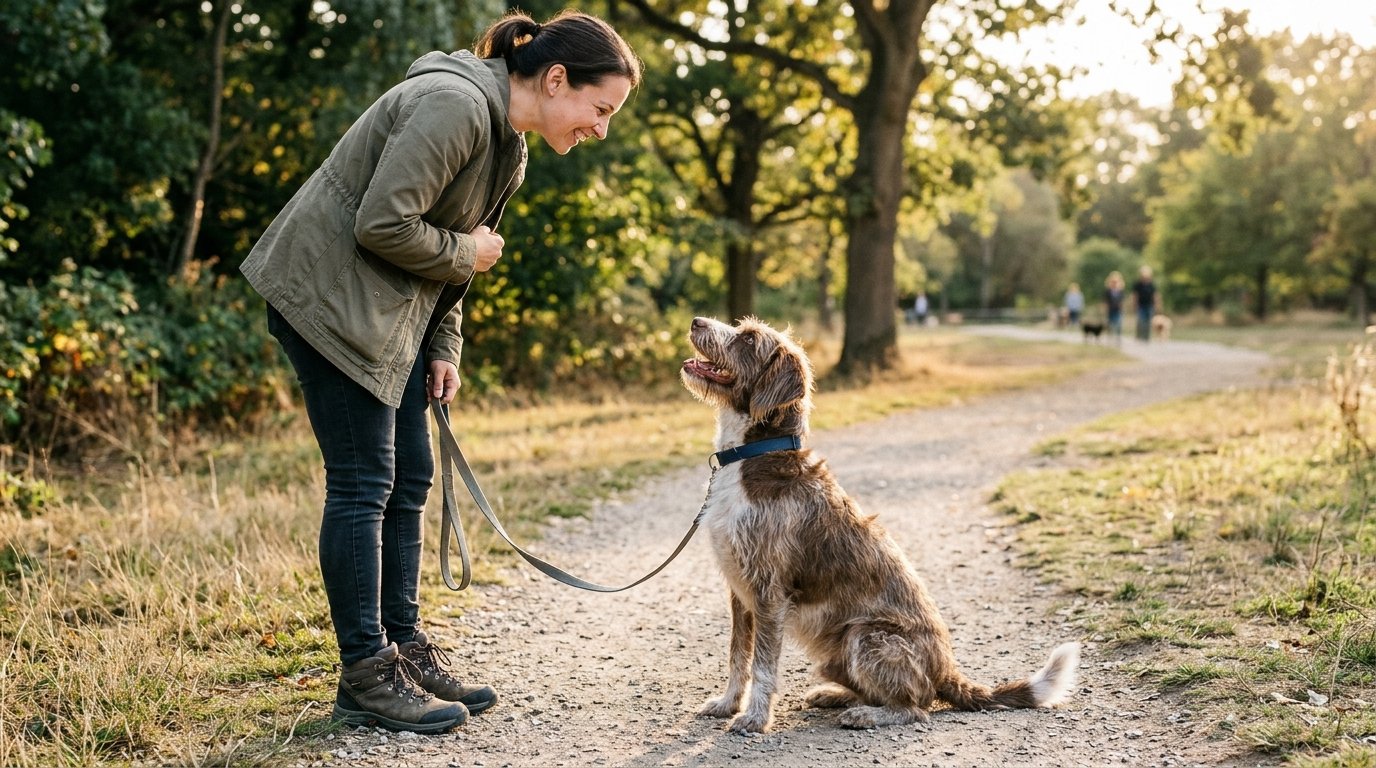
    A dog calmly checking in with its owner during an outdoor training session on a loose leash
    A dog who checks in voluntarily isn’t obeying out of pressure — they’ve learned that paying attention pays off.

    Start With One Observable Behavior

    Training becomes clearer when the goal can be seen. “Be calmer” is not yet a behavior. “Put four paws on the floor when a guest walks in” is. “Look back at me when we notice a dog across the street” is. “Walk to the mat when the doorbell rings” is.

    A clear behavior lets you notice success, deliver a reward at the right moment, and make the next practice session more realistic. It also keeps the work out of the old stories about attitude, status, or stubbornness.

    Outdated Frame

    “My dog knows better and is choosing to challenge me.”

    Better Question

    “What has this dog learned here, and what is the environment making likely right now?”

    Make Success Easier Before You Ask for More

    Every dog learns in context. A cue that works in the kitchen may not yet be available in a busy park. That is not failure; it is information about the current difficulty level.

    Before increasing the challenge, change one variable at a time. You might begin farther from a distraction, practice for fewer seconds, reduce the noise level, use a more valuable reward, or choose a time when your dog is better rested. The goal is not to prove that a dog can withstand more pressure. The goal is to create repetitions that help the dog understand what works.

    Veterinary behavior guidance on desensitization and counterconditioning follows the same principle: exposure should begin at a level that does not produce fear or stress, then become gradually more difficult only while the learner remains comfortable enough to participate.

    Timing Is Part of the Message

    Reinforcement works by changing what is likely to happen next. To make that message clear, the reward needs to arrive close to the behavior you want to build. If you are teaching a dog to pause with four paws on the floor, notice and reinforce the pause—not the jump that happened just before it or the bark that happens after it.

    This is exactly where the right tools quietly make or break your training. The gap between a behavior and its reward should be under a second — and two small pieces of gear make that possible. A training clicker lets you mark the precise instant your dog gets it right, far more sharply than a word filtered through your tone. And keeping rewards in a treat pouch at your waist means the reward follows that mark instantly, instead of arriving late while you dig through a pocket — by which point your dog has already moved on to a different behavior.

    The reward itself is individual. For one dog, a small piece of food may be useful. For another, access to a sniffy patch of grass, a toy, a game, distance from something uncomfortable, or calm social contact may matter more. VCA explains that reinforcement is defined by its effect: it is something that increases the future likelihood of a behavior for that particular learner.

    Food can be part of training, but it is not the whole system. It is simply one way to make information clear. If your dog has a medical condition, dietary restriction, or history around food that concerns you, ask your veterinarian what is appropriate before changing their routine.

    Reward-based learning asks us to notice more, not demand less.

    Teach First. Then Practice the Real-Life Version.

    New skills are easiest to learn in a low-pressure setting. Teach the first version where your dog is able to think, move, and take a reward comfortably. Once the pattern is reliable, practice it in gradually different rooms, at different times of day, and around mild distractions.

    Only then does it make sense to bring the skill toward the real-world situation that matters. If the dog cannot do it there yet, that is a cue to reduce difficulty—not to repeat the cue louder or add a correction.

    The International Association of Animal Behavior Consultants places this inside a broader welfare framework: consider the animal’s physical and emotional wellbeing, environment, safety, health, learning history, and opportunities for choice and control before choosing a procedure.

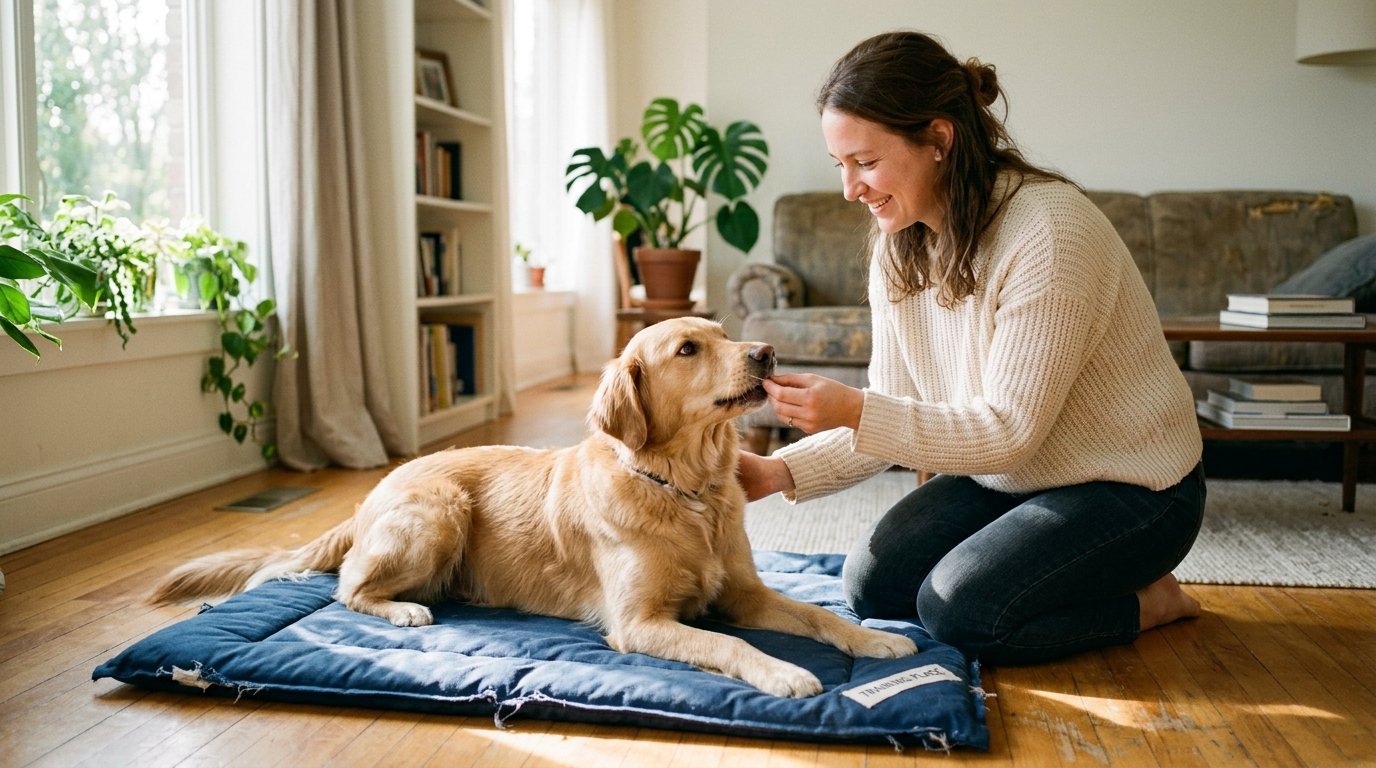
    A person rewarding a relaxed dog resting on a mat at home, calm low-pressure training environment
    Skills are built in calm, low-pressure settings first — then gradually taken into the real world.

    What to Do When a Practice Repetition Falls Apart

    One missed repetition does not mean the dog is refusing to learn. It usually means the plan asked for more than the dog could comfortably do in that moment.

    Pause. Create space. Simplify the task. End the session with something your dog can do easily. Then use the information to adjust the next setup. This is not lowering your standards. It is how you build a skill that can hold up outside a perfect training session.

    When to Get Help

    Contact a veterinarian if your dog’s behavior changes suddenly, if pain, illness, sensory change, or medication could be involved, or if your dog seems distressed. Seek a qualified, force-free behavior professional when fear, reactivity, aggression, self-injury, or safety concerns are present or increasing.

    A good professional should be able to explain what they are teaching, why the method fits your dog’s welfare, how they will prevent unnecessary fear, and how progress will be measured. Punishment is not a shortcut around assessment.

    The Petz We Love Standard

    Reward-based learning asks us to notice more, not demand less. It asks us to define the next useful behavior, make success possible, reinforce with precision, and change the setup when the dog is struggling.

    That is not a weaker relationship. It is a clearer one.

    Free Download

    5 Things You Were Taught About Pet Care That Science Says Are Wrong

    A practical starting point: the inherited ideas to reconsider, and the evidence-led questions to ask instead.

    Get the Free Guide →

    Keep Reading


    Sources and further reading

    1. American Veterinary Society of Animal Behavior. Position Statements and Handouts.
    2. VCA Animal Hospitals. Reducing Fear and Stress with Desensitization and Counterconditioning.
    3. VCA Animal Hospitals. Using Reinforcement and Rewards to Train Your Pet.
    4. International Association of Animal Behavior Consultants. Standards of Practice.

    This article is for general educational purposes and isn’t a substitute for personalized guidance from your veterinarian or a qualified, credentialed behavior professional.

  • Your Dog Isn’t “Dominant” — That Word Is Doing You a Disservice

    Your Dog Isn’t “Dominant” — That Word Is Doing You a Disservice

    Your Dog Isn’t ‘Dominant’ — That Word Is Doing You a Disservice | Petz We Love

    Your Dog Isn’t “Dominant” — That Word Is Doing You a Disservice

    Published: July 2026 | Reading time: 8 minutes | For: Dog owners ready to see their dog’s behavior through science, not mythology

    This article contains affiliate links. As an Amazon Associate we earn from qualifying purchases, at no extra cost to you. We only recommend products and programs that fit our force-free, science-backed approach. Learn more.

    The Word That’s Been Holding You Back

    If someone has ever told you your dog is “trying to dominate you,” you’ve heard one of the most persistent myths in dog training—and unfortunately, one of the most damaging to your relationship with your dog.

    The story is familiar: your dog jumps on you, pulls on the leash, or eats something off the counter, and somewhere along the line, you’ve heard that this is dominance behavior—an attempt to establish “pack leadership” and assert control. The implication? You need to show your dog “who’s boss.”

    Here’s what the science actually says: that framework has been abandoned by the very researchers who originally proposed it. And holding onto it is likely making your dog’s behavior worse, not better.

    The Dominance Myth: Where It Came From (and Why It Failed)

    The dominance theory has a surprisingly short shelf life in behavioral science. It all started with observations of captive wolf packs in the 1960s and 70s. Researchers noticed that in artificial pack settings, certain wolves controlled resources and made decisions—so they labeled those wolves “alpha” or “dominant,” and the theory suggested domestic dogs carried the same hierarchical drive.

    The problem? The research was built on a flawed foundation.

    In 1999, one of the original wolf researchers, L. David Mech, published a landmark paper retracting the entire premise. He explained that wild wolf packs don’t function like the captive packs that inspired the theory—they’re family units led by the parents, not dominance hierarchies. And the behaviors researchers had labeled as “dominance bids” were just… normal family dynamics.

    ✗ The myth: Dogs are trying to “dominate” you and establish pack hierarchy.

    ✓ The science: The foundational wolf research has been retracted. Domestic dogs don’t have the same hierarchy drive, and their behavior is shaped by reinforcement, not social rank.

    Yet the mythology persisted. It became entertainment, it became dogma in certain training circles, and most importantly, it became the lens through which millions of dog owners interpreted their dogs’ behavior. And that lens distorts everything.

    What Your Dog Is Really Doing (Hint: It’s Not About Power)

    So if your dog isn’t trying to dominate you, what are they doing? Let’s look at the behaviors often labeled “dominance” and what they actually mean:

    Jumping on You or Others

    The dominance story: “My dog jumps on people because he’s trying to assert dominance.”

    What’s actually happening: Your dog jumps because jumping has been rewarded. He jumped once, you reacted (even if negatively—attention is attention), and from his perspective, jumping = engagement. This is learned behavior reinforced by history, not a bid for social rank.

    Pulling on the Leash

    The dominance story: “My dog pulls because he’s trying to be the leader.”

    What’s actually happening: Your dog pulls because something ahead is more rewarding than staying with you. He’s motivated by the environment, not by a desire for power. He’s learned that pulling sometimes gets him to interesting things. The reinforcement history is the problem, not his rank.

    Resource Guarding

    The dominance story: “My dog guards his food/toys because he’s asserting dominance over the household.”

    What’s actually happening: Your dog has learned that when you approach his resources, something bad might happen (or something good might be taken away). This is anxiety-driven behavior rooted in his emotional state and past experience, not a power play.

    ✓ The reality: Dog behavior is shaped by reinforcement history and emotional state, not by a drive to dominate. What looks like dominance is usually one of three things: learned behavior that’s been rewarded, anxiety about resources or situations, or an unmet need for engagement, exercise, or enrichment.

    Why the Dominance Frame Actually Damages Your Relationship

    If dominance theory is scientifically outdated, why does it matter what you call it? It matters because the label shapes your response—and your response shapes your dog’s future behavior.

    If you believe your dog is trying to dominate you, the prescription is often to “establish leadership” through control: corrections, withholding affection, enforced submission. The goal is to “show them who’s boss.”

    But here’s the problem: that approach is built on a false premise. Your dog isn’t trying to challenge your authority. And when you respond to normal dog behavior (jumping, pulling, curiosity) with corrections or intimidation, you’re not addressing the actual cause—you’re adding fear and stress to the mix.

    The result? Your dog learns to fear you, not to understand what you actually want. His anxiety increases. His behavior may appear to improve (because he’s now scared to act), but the underlying problem—the unmet need, the learned behavior, the emotional state—is still there.

    Reframing: The Shift That Changes Everything

    Instead of asking “Is my dog trying to dominate me?”, ask these questions:

    1. What is my dog getting out of this behavior?

    Is he getting attention? Access to something? Escape from something uncomfortable? Once you identify the reinforcement, you can redirect it. Jumping gets him attention? Teach him that calm sitting gets attention instead.

    2. Is there an underlying emotional state?

    Is your dog anxious? Frustrated? Overstimulated? A dog guarding resources might be fearful, not dominant. A dog who’s reactive on leash might be frustrated or anxious, not trying to lead the pack. Address the emotion, and the behavior often resolves.

    3. What does my dog actually need that he’s not getting?

    Many behaviors labeled “dominance” are actually signs of boredom, under-stimulation, or lack of clear boundaries. A dog who pulls constantly might need more exercise. A dog who jumps might need engagement and mental enrichment. Meet the need, and the behavior changes.

    ✓ The framework: Behavior = Reinforcement History + Emotional State + Unmet Need. Once you shift from “dominance” to this model, solutions become clear and compassionate.

    From Myth to Science: A Real Example

    The old story: “My dog jumps on guests because he’s trying to establish dominance. I need to correct this by intimidating him so he learns his place.”

    The science-backed approach: “My dog jumps on guests because he’s excited and that behavior has been rewarded with attention in the past. I’m going to teach him that all four paws on the ground is what gets rewarded with attention instead.”

    Then you teach an incompatible behavior (sit or down), reward it heavily when guests arrive, and manage the environment so guests don’t accidentally reward jumping by petting or talking to him while he’s jumping.

    Does this take longer than a quick correction? In the moment, maybe. But six months later, you have a dog who genuinely understands what you want—not a dog who’s just scared of you when you’re watching.

    But What If My Dog Really Is Trying to Take Over?

    This is the question we hear most often, so let’s address it directly: he isn’t.

    Dogs don’t have an intrinsic drive to control human households. They don’t wake up plotting to establish authority. Hundreds of peer-reviewed studies in applied animal behavior have moved past the dominance model because it simply doesn’t describe how dogs work.

    If your dog is exhibiting challenging behavior, it’s not because he’s trying to dominate. It’s because:

    • He’s learned that behavior gets him something he wants (attention, access, escape)
    • He’s anxious, frustrated, or overstimulated
    • He doesn’t understand what you’re asking for
    • His needs aren’t being met (exercise, enrichment, structure)

    Those are solvable problems. Dominance isn’t a problem at all—it’s a misdiagnosis that points you in the wrong direction.

    Why This Matters Beyond Your Front Door

    The dominance myth isn’t just a matter of outdated theory. It has real consequences. Dogs labeled “dominant” or “alpha” are often subject to harsher training methods. Behavior problems that should be addressed with compassion and understanding get treated with intimidation. Dogs suffer unnecessarily.

    And on the flip side, dog owners who internalize this myth often experience anxiety and conflict in their relationships with their dogs. They second-guess themselves. They’re afraid their dog is plotting against them. They miss the genuine connection that comes from understanding what their dog actually needs.

    Moving past the dominance myth is liberating. It lets you see your dog clearly, respond effectively, and build a relationship based on mutual understanding instead of power dynamics.

    Ready to See Your Dog’s Behavior Through Science?

    If you’ve been caught up in the dominance frame, you’re not alone—and it’s not your fault. This myth has been reinforced by TV personalities and old-school trainers for decades. But the science has moved on, and your dog will thrive when you do too.

    Start by reframing one behavior that’s been bugging you. Instead of “dominance,” ask: What is my dog actually getting from this behavior? What does he need? What can I teach him instead?

    Then take the quiz to discover your pet care style and get personalized insights on the myths holding you back.

    Take the Quiz →

    Sources & Further Reading

    • Mech, L.D. (1999). “Alpha status, dominance, and division of labor in wolf packs.” Canadian Journal of Zoology. The landmark paper retracting the dominance hierarchy model in wolf packs.
    • American Veterinary Society of Animal Behaviorists (AVSAB). Position statements on dominance-based training methods and force-free approaches. avsab.org
    • Zach George. “Dominance in Dogs” and related research compilations on applied dog behavior and learning theory.
    • Kikopup (Emily Larlham). Video series on operant conditioning, positive reinforcement, and why dominance theory fails to predict dog behavior.
    • VCA Animal Hospitals. Behavioral resources on dog aggression, resource guarding, and anxiety-driven behaviors (vca.com).

    Want more science-backed pet care insights? Download your free guide or explore the blog.